 Fordel Studios
Manufacturing
Lights-out factories aren't a roadmap item anymore — certain automotive and electronics facilities run overnight without operators today. Landing AI and Cognex are deploying computer vision inspection at production line speeds, replacing statistical sampling with 100% inline defect detection. NVIDIA Omniverse and Siemens Xcelerator digital twins are moving from pilot programs into standard engineering practice for new line commissioning. The reshoring wave is generating greenfield factory deployments where Industry 4.0 infrastructure gets designed in from day one rather than bolted onto 30-year-old OT networks.
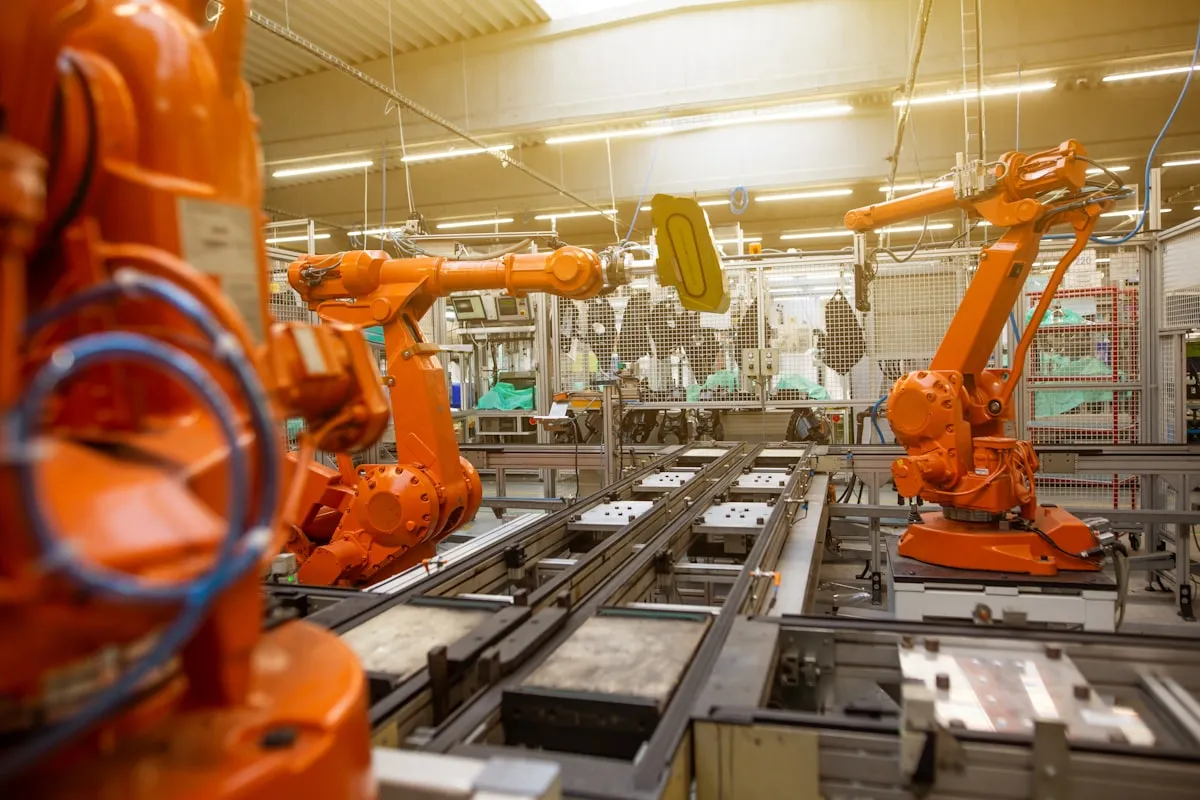
Manufacturing AI is past the capability gap and into the deployment gap. The models for predictive maintenance, quality inspection, and production optimization are proven. NVIDIA Omniverse and Siemens Xcelerator have productized digital twin infrastructure. Landing AI and Cognex have productized AI vision inspection. The deployment constraint is OT integration — connecting these systems to factory floor infrastructure that predates the assumption of IP connectivity — and the safety engineering required to do it without creating new failure modes.
The OT/IT Convergence Reality
IEC 61508 defines safety integrity levels for programmable safety systems. OPC-UA is the dominant industrial protocol for machine data access. PROFINET and Modbus are still running on PLCs in factories built in the 1990s. A PLC control loop may have a 10ms scan cycle. A network hiccup causing a 2-second timeout, acceptable in a web application, will cause a control loop failure on the factory floor. AI systems deployed by teams without OT knowledge will encounter these failure modes and often misattribute them to model problems rather than infrastructure problems.
The historian data extraction problem is equally important. OSIsoft PI System stores billions of time-series data points from factory floor sensors. Extracting the right subset, cleaning it (sensor failures, calibration drift, transmission errors are all common), and feeding it to AI models requires purpose-built data pipelines — not generic ETL tools that assume reliable, complete, well-formatted source data.
AI Vision Inspection: Deployment Engineering
| Inspection Type | AI Advantage | Key Engineering Requirement |
|---|---|---|
| Surface defect detection | Consistent at line speed across all shifts | Camera placement, lighting design, inference latency <50ms |
| Dimensional measurement | Sub-millimeter precision on every part | Calibration maintenance, thermal compensation |
| Assembly verification | Part presence and orientation at line speed | Multi-angle coverage, occlusion handling |
| Weld quality | Evaluation beyond visual — subsurface | Specialized sensors (X-ray, ultrasound) + AI analysis |
| Label/marking verification | Fast, accurate barcode and OCR at speed | OCR fine-tuning for facility-specific fonts and conditions |
Deploying Manufacturing AI in Production
Audit the quality, completeness, and calibration status of sensors before committing to a model design. Missing or noisy sensors must be addressed at the hardware layer — no model can compensate for bad data, and confident wrong predictions are worse than no predictions.
Manufacturing AI that requires cloud round-trips will fail when network connectivity is interrupted — and factory floor network reliability is not equivalent to data center network reliability. Deploy inference at the edge (plant floor servers, industrial PCs) with cloud connectivity for model updates and monitoring only.
For safety-critical defect detection, define the acceptable false negative rate before model selection — this rate comes from the product safety requirement, not from accuracy benchmarks. Design annotation volume and model architecture around meeting this constraint.
Deploy AI process control in advisory mode first — AI recommends, operator approves. Move to autonomous execution only after establishing a track record and obtaining safety review sign-off under IEC 61508 or ISO 13849. Always maintain a manual override that the AI system cannot countermand.
- 01
OT/IT convergence is a real discipline: IEC 61508 functional safety, OPC-UA and PROFINET protocol stacks, and PLC real-time reliability requirements are categorically different from IT infrastructure — AI systems built by IT teams without OT knowledge create failure modes that are hard to diagnose and potentially unsafe
- 02
Predictive maintenance requires historian data and calibrated sensor coverage that most older facilities don't have — retrofit sensor deployment and connectivity validation is a prerequisite for the AI, not something you can run in parallel with model development
- 03
AI quality inspection systems must perform at production line speeds with near-zero false negative rates for safety-critical defects — the annotation quality requirements and lighting geometry constraints are significantly harder than typical CV applications
- 04
Digital twins require a live synchronization pipeline pulling OPC-UA streams, historian data, quality system data, and ERP data into a unified model that updates faster than the physical process changes — that integration work is harder and more expensive than the simulation model itself
- 05
Cobots with AI vision operating near humans must comply with IEC 61508 and ISO 13849 functional safety requirements — safety architecture is an engineering constraint, not a checkbox after the system is built
- 06
Generative design tools produce geometries that may be optimal by simulation but unproducible by the actual facility — AI output must be constrained by the manufacturing capabilities on site, or it generates designs nobody can build
We treat OPC-UA connectivity, historian extraction, and signal quality validation as the first phase of every manufacturing AI engagement — models trained on noisy or miscalibrated sensor data produce worse decisions than no AI, and we've seen that failure mode enough times to make it non-negotiable
IEC 61508 safety scoping happens before any inference code is written — we work with the safety engineers and controls engineers on site, the people who know the failure modes, not just the product owner who wants a demo
For AI quality inspection, false negative rate is the primary design constraint, not overall accuracy — a 99.5% accurate model with a 0.3% false negative rate on brake components is a liability event, not a success metric
Digital twin engagements are scoped around the data synchronization architecture first — we've seen projects spend 80% of budget on 3D visualization and deliver a demo that can't be operationalized
Lights-out operation design starts with exception taxonomy: mapping every failure state that currently goes to a human operator and designing an automated response — the exception handling logic is more important than the happy-path model
01Lights-Out Operation Is an Exception Handling Problem
The facilities that have achieved lights-out operation invested heavily in exception taxonomy before automation — mapping every failure state that currently goes to a human operator and designing an automated response for each one. A human operator in a traditional facility provides the exception handling that's hard to automate: sensor failures, material jams, quality excursions, safety interlocks. The automation of the normal case is the easy part. Building toward lights-out requires methodically working through the exception register, not just optimizing throughput on the happy path.
02Digital Twin Value Is in the Data Pipeline, Not the 3D Model
NVIDIA Omniverse and Siemens Xcelerator produce impressive visual output, but the operational value of a digital twin comes from live synchronization between the model and the physical plant — real-time monitoring, predictive analytics, and scenario simulation against a model that reflects current plant state. Building that pipeline means integrating OPC-UA streams, historian data, quality system data, and ERP data into a unified model that updates faster than the physical process changes. Projects that budget heavily for the simulation environment and lightly for data integration deliver a visualization demo, not an operational asset.
03Predictive Maintenance: The Model Is Straightforward; the Sensor Infrastructure Isn't
Unplanned downtime in manufacturing costs 5-20x more than planned maintenance windows. AI models that detect equipment degradation 2-6 weeks before failure — using vibration, temperature, current signature, and oil analysis from historian time-series — convert unplanned failures into scheduled events. The models aren't exotic: gradient boosting and anomaly detection on historian data works well for most rotating equipment. The hard engineering work is the sensor retrofit on older equipment, historian connectivity, and signal quality validation. Facilities that have done the infrastructure work consistently find the predictive model to be the easy part.
Lights-out factory expansion moving from electronics into automotive, pharmaceutical, and food manufacturing — facilities designed from commissioning for minimal human intervention, not retrofitted
100% inline AI inspection replacing statistical sampling — Landing AI and Cognex deployments catching defects before assembly at production line speeds, eliminating end-of-line sampling gaps
Digital twins transitioning from pilot to standard engineering practice — Siemens Xcelerator and NVIDIA Omniverse being used for new line commissioning and process optimization, not just visualization
Cobots with AI vision (Universal Robots plus third-party AI integration) expanding the task range for collaborative automation without dedicated fixturing — increasing flexibility on mixed-product lines
Reshoring and nearshoring creating greenfield factory AI opportunities — new facilities built with modern OT infrastructure, OPC-UA native, where Industry 4.0 systems don't need to coexist with legacy SCADA
Generative design (Autodesk Fusion) entering production engineering workflows — AI-generated geometries constrained by manufacturing process capabilities and material specs, shortening design iteration cycles
- 01
Starting model development before validating sensor data quality and historian connectivity — noisy, missing, or miscalibrated sensor data produces AI that is confidently wrong in ways that don't surface until a physical failure, often months later
- 02
Deploying AI quality inspection without validating at production line speed and with production lighting geometry — a model that hits 99% accuracy in controlled testing may drop to 85% at line speed with suboptimal lighting, which is worse than the sampling process it replaced
- 03
Skipping IEC 61508 functional safety analysis for cobots and AI-controlled actuators operating near workers — creates OSHA compliance exposure and genuine safety risk, and retrofitting safety architecture after the system is built is significantly more expensive than scoping it upfront
- 04
Underinvesting in the data synchronization pipeline for digital twin projects and overinvesting in the 3D environment — results in a visualization demo that can't be used for real-time monitoring or predictive analytics
- 05
Training predictive maintenance models at one facility and deploying at others without revalidation — equipment vintage, operational practices, and environmental conditions vary enough across sites to invalidate transfer assumptions, and the failure mode is a model that appears to run but misses actual degradation events
OSHA machine guarding standards and lockout/tagout (LOTO) requirements apply to any AI system that controls or interacts with physical equipment near workers — these aren't advisory. IEC 61508 and ISO 13849 define safety integrity levels for AI controlling safety-critical functions; the EU Machinery Regulation (2023/1230) adds AI-specific provisions for autonomous machinery sold in EU markets. Pharmaceutical and medical device manufacturing falls under FDA 21 CFR Part 11 for electronic records, requiring validated software processes for any AI touching process control. Defense contractors on OT networks face CMMC requirements, and EPA Clean Air Act and Clean Water Act permit conditions constrain what AI process optimization can autonomously adjust in process manufacturing.
We start manufacturing AI engagements with OPC-UA connectivity, historian data extraction, and signal quality analysis — no model development until we understand what the sensor data actually looks like at production conditions. Quality inspection systems are designed around false negative rate as the binding constraint, with lighting geometry and line speed validation before annotation work begins. For digital twins, we scope the data synchronization pipeline before the simulation environment — the pipeline is where these projects succeed or fail. Safety scoping (IEC 61508, ISO 13849) happens in the first week alongside the controls engineers, not in a review after the system is built.
Ready to build for Manufacturing?
We bring domain expertise, not just engineering hours.
Start a ConversationFree 30-minute scoping call. No obligation.