 Fordel Studios
Agricultural Monitoring & Recommendation Agent
Field-level crop insights from satellite and sensor data, without the agronomist bottleneck.
The problem
being solved
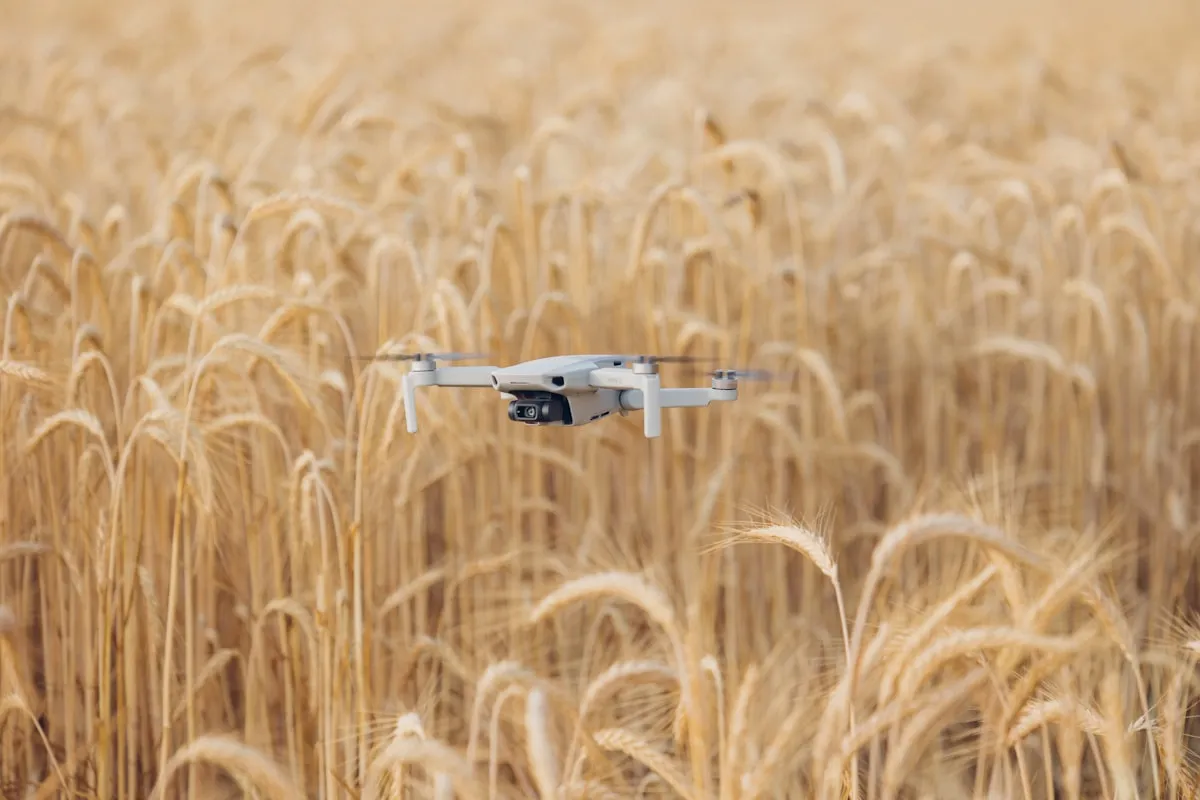
Modern row crop farming operates at a scale that makes field-by-field, plant-by-plant monitoring impractical through human observation. A 5,000-acre corn and soybean operation has too many acres for timely scouting of every field. By the time a problem — disease pressure, pest infestation, nutrient deficiency — is visible to a scout walking the field, the economically optimal treatment window may have passed.
The data is available. Satellites capture multispectral imagery at 3–5 meter resolution every few days. Weather stations provide hyper-local data. Soil sensors report moisture and temperature at depth. Connected equipment records yield maps and application data. The constraint is not data — it is synthesis: someone or something must monitor all of it continuously and surface the actionable decisions before the window closes.
John Deere's See & Spray technology demonstrated that computer vision applied to in-field imagery can identify weeds at the plant level and apply herbicide selectively, reducing herbicide use by up to 77% on labeled crops. Taranis's remote sensing platform identifies disease and pest pressure from aerial and satellite imagery before it is visible from the field edge. The underlying insight is the same: AI can monitor at a resolution and frequency that human scouting cannot match economically.
How this
agent works
The Agricultural Monitoring & Recommendation Agent continuously monitors configured fields using satellite imagery, weather data, soil sensor readings, and connected equipment data. It identifies developing problems — disease pressure, pest activity, nutrient stress, irrigation needs — and generates field-specific management recommendations before the window for cost-effective intervention closes.
The agent delivers daily field status summaries and exception alerts to the farm manager or agronomist. When satellite imagery shows early-stage disease signatures in a specific field zone, the agent flags it with a recommended scouting route and, once confirmed by the agronomist, generates a treatment recommendation with timing and rate. Variable-rate prescription maps are generated for equipment that supports them.
Agronomists review and approve recommendations. The agent provides the monitoring and pattern recognition; the agronomist applies local knowledge and makes the management decision.
A Python ingestion pipeline (rasterio, GDAL) pulls multispectral imagery from Planet, Sentinel-2, and Maxar on arrival and computes NDVI, NDRE, and NDWI indices across field zones as daily batch jobs. Anomaly classification runs through custom computer vision models trained on labeled crop stress datasets, with weather risk overlays pulled from NOAA, DTN, and on-farm station APIs. LangGraph orchestrates the multi-step reasoning loop — from anomaly detection through disease risk scoring to recommendation generation — with Claude handling the field report narrative and agronomic rationale. Prescription maps export as GeoTIFF formatted for major precision agriculture platforms; spatial data lives in PostGIS with Redis caching hot field state between imagery cycles.
A farm management company oversees 25,000 acres of row crops across 15 farms for 8 client landowners. Four agronomists handle all scouting, monitoring, and management decisions. Physical field scouting covers each field approximately once per week in-season — sufficient for detecting established problems, insufficient for early detection.
After deploying the monitoring agent, satellite imagery and sensor data are analyzed daily for all 25,000 acres. Agronomists receive exception alerts for fields showing stress signatures, with preliminary analysis completed. Scouting time is directed to confirmed problem areas rather than routine grid scouting.
These projections are informed by Taranis's published crop intelligence outcomes data and USDA research on precision agriculture adoption and economic impact.
| Metric | Before | After |
|---|---|---|
| Field monitoring frequency | Once per week physical scouting | Daily satellite analysis + physical scouting directed to flagged areas |
| Disease detection timing | Visual confirmation at field edge (often post-threshold) | Spectral signature detection 7–14 days before visual symptoms |
| Herbicide application targeting | Broadcast application across full field | Variable-rate prescription map targeting weed-present zones |
- 01
Multispectral Imagery Analysis
Processes Planet and Sentinel-2 imagery at field-zone resolution, computing NDVI, NDRE, and NDWI on each delivery. Stress signatures — nutrient deficiency, pest pressure, moisture stress, disease onset — are classified by type and severity using CV models trained on annotated crop stress data. Index trends are tracked over the season to separate emerging problems from stable spatial variation.
- 02
Weather-Driven Disease Risk Modeling
Pulls hyper-local temperature, humidity, precipitation, and degree-day accumulation from NOAA, DTN, and connected on-farm weather stations. Runs those inputs through disease pressure models for gray leaf spot, northern corn leaf blight, and soybean rust to flag fields entering high-risk infection windows. Risk scores update daily and feed directly into the recommendation layer.
- 03
Variable-Rate Prescription Generation
Combines zone-level imagery analysis and risk scores to generate nutrient, pesticide, and irrigation prescriptions at sub-field resolution. Output is GeoTIFF formatted for John Deere Operations Center, Climate FieldView, and other ISO 11783-compliant platforms. Prescription rationale is logged alongside each map so agronomists can audit and override decisions.
- 04
Scouting Route Optimization
When anomalies are flagged, the agent generates field scouting routes that prioritize high-severity zones and account for field access points and equipment size. Routes are delivered to field staff with the flagged issue context attached. Scouting observations submitted from the field write back to the field record and can trigger updated management recommendations.
- 05
Season-Long Field Record Management
Every field maintains a structured season record in PostGIS: imagery archive, weather history, scouting reports, input applications, management decisions, and yield data from connected harvesters. Records are structured to support crop insurance documentation, agronomic analysis across seasons, and multi-farm benchmarking. Data is queryable at the zone level, not just the field level.
Build this agent
for your workflow.
We custom-build each agent to fit your data, your rules, and your existing systems.
Free 30-min scoping call